Rust + Go Hybrid Architectures: What 6 Months Taught Me About Java's Middle Ground
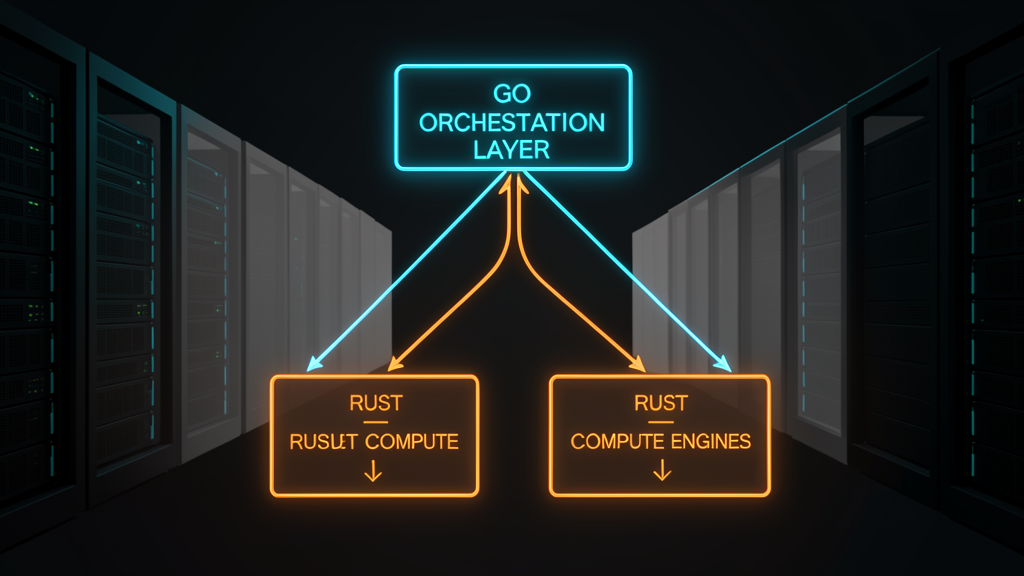
After writing about what Rust taught me regarding Java’s blind spots, and what GraalVM taught me about Rust’s real advantage, a lot of you asked the question I was avoiding: “If Rust is so fast and Go is so productive, why pick one? Why not both?”
So I built a hybrid backend — Go for the orchestration layer, Rust for the CPU-intensive hot paths — and ran it alongside our Java Spring Boot monolith for 6 months. The results surprised me. Not because Rust was fast (I expected that), but because Go was the glue that made the whole thing work without turning our infrastructure into a distributed systems nightmare.
Here’s what actually happened when I stopped treating this as a language debate and started treating it as an architecture problem.
The Problem Java Couldn’t Solve (Again)
Let me be clear: Java isn’t bad. I’ve shipped production systems on Spring Boot for over a decade. But there’s a specific problem pattern that Java struggles with — one I keep encountering:
You have a service that’s 80% boring CRUD and 20% computational nightmare.
In our case, it was a document processing pipeline. Ingest PDFs, extract text, run NLP classification, generate embeddings, store results. The CRUD parts (user auth, file uploads, result storage) were trivial in Spring Boot. The NLP and embedding parts? That’s where the JVM tax became visible:
- GC pauses during large document batches (340MB heap, 200ms pauses)
- Thread-per-request model hitting limits at ~400 concurrent document processing tasks
- Binary size of 280MB for a service that should be doing one thing
I could throw more containers at it. But at some point, you’re not optimizing architecture — you’re just paying Amazon more money.
Why Not Just Go?
Go was the obvious first choice. Fast compilation, simple deployment, goroutines handle concurrency elegantly. I rewrote the service in Go (using Gin + standard library), and it was better:
// Go: Document ingestion API — simple, fast to write
func (s *Server) ProcessDocument(c *gin.Context) {
    file, err := c.FormFile("document")
    if err != nil {
        c.JSON(400, gin.H{"error": err.Error()})
        return
    }

    // Hand off to processing pipeline
    result, err := s.pipeline.Process(file)
    if err != nil {
        c.JSON(500, gin.H{"error": "processing failed"})
        return
    }

    c.JSON(200, result)
}
Go handled the HTTP layer beautifully. Goroutines scaled to thousands of concurrent connections. But when I profiled the NLP classification — the actual CPU-intensive work — Go hit a wall:
- JSON serialization: 890K/s (fine, but not great)
- Text tokenization: 5.2x slower than the Rust equivalent
- Memory per 10K connections: 78MB vs Rust’s 45MB
- P99 latency under load: 3.8ms vs Rust’s 2.1ms
Go’s GC, even in Go 1.24 with sub-millisecond pauses, still introduced tail latency spikes during batch processing. When you’re classifying 10,000 documents and each classification allocates temporary buffers, the GC doesn’t care about your SLA — it collects when it needs to.
Why Not Just Rust?
I’d been down this road. After 6 months of Rust (documented in my previous articles), I know the trade-offs:
- Compile times: 42 seconds for a full clean build vs Go’s 3.2 seconds
- The borrow checker: I still fight it when data flows through 5 layers of abstraction
- Hiring: finding a senior Go developer is easy. Finding one who also knows Rust? That’s a different salary bracket ($185K–$230K vs $160K–$200K)
- Ecosystem gaps: Go’s standard library has everything. Rust’s
tokio,serde, andsqlxcover 80% of backend needs, but the other 20% requires reaching for crates with 3 GitHub stars and last commit from 2023
Writing the entire document processing service in Rust would be like using a scalpel to butter toast. Technically impressive, practically wasteful.
The Hybrid Pattern: Go Orchestration + Rust Hot Paths
Here’s what I actually deployed, and what’s been running in production for 6 months:
┌──────────────────────────────────────────┐
│           Go (Orchestration)             │
│  ┌────────┐  ┌────────┐  ┌────────────┐  │
│  │  Auth   │  │ Upload  │  │  Results   │  │
│  │  CRUD   │  │ CRUD    │  │  Storage   │  │
│  └────┬───┘  └────┬───┘  └─────┬──────┘  │
│       └───────────┼────────────┘          │
│                   │ gRPC                  │
│                   ▼                       │
│           Rust (Hot Path)                 │
│  ┌──────────────────────────────┐         │
│  │  NLP Classification Pipeline  │         │
│  │  Embedding Generation         │         │
│  │  Real-time Scoring            │         │
│  └──────────────────────────────┘         │
└──────────────────────────────────────────┘
Go handles everything that doesn’t need extreme performance: authentication, file upload handling, result storage, health checks, metrics. The stuff that’s 90% HTTP routing and 10% business logic. Go’s goroutines handle thousands of concurrent connections effortlessly, and the code reads like pseudocode.
Rust handles the actual document processing — the part that chews through CPU cycles. It receives gRPC requests from the Go layer, processes documents, and returns results. No GC pauses. No memory fragmentation.
The Rust Hot Path
// Rust: CPU-intensive document classification
use tokio;
use tonic::{Request, Response, Status};

pub struct ClassificationService {
    model: NLPModel, // Pre-loaded ML model
}

#[tonic::async_trait]
impl DocumentProcessor for ClassificationService {
    async fn classify(
        &self,
        request: Request<ClassifyRequest>,
    ) -> Result<Response<ClassifyResponse>, Status> {
        let doc = request.into_inner();

        // Zero-allocation tokenization
        let tokens = self.model.tokenize(&doc.text);

        // Batch inference — the part that matters
        let scores = self.model.predict_batch(&tokens);

        Ok(Response::new(ClassifyResponse {
            categories: scores.top_k(5),
            confidence: scores.max(),
            processing_time_ms: doc.processing_time(),
        }))
    }
}
The key insight: the Rust service has zero HTTP logic, zero auth logic, zero database logic. It does one thing — classify documents — and it does it fast. No framework overhead, no middleware chain, no connection pool management. Just computation.
The Go-to-Rust Communication
I tried two approaches. Here’s the honest comparison:
Approach 1: gRPC (what I actually use)
// Go side: calling Rust via gRPC
func (s *Server) callRustClassifier(ctx context.Context, doc *Document) (*Classification, error) {
    conn, err := grpc.Dial("rust-processor:50051", grpc.WithTransportCredentials(insecure.NewCredentials()))
    if err != nil {
        return nil, err
    }
    defer conn.Close()

    client := pb.NewDocumentProcessorClient(conn)
    resp, err := client.Classify(ctx, &pb.ClassifyRequest{
        Text:     doc.Text,
        Language: doc.Language,
    })

    return toClassification(resp), err
}
Pros: clean interface, strongly typed, works across containers. Cons: serialization overhead (protobuf is fast, but not free). For our workload, gRPC adds ~200μs per call — acceptable when each classification takes 15ms anyway.
Approach 2: CGO/FFI (what I tried and abandoned)
Calling Rust directly from Go via CGO is technically possible (compile Rust to a .so or .a, link with CGO). But it couples your deployment lifecycle, makes container images ugly, and debugging cross-language panics is the kind of fun I don’t need at 2 AM.
Stick with gRPC. The overhead is negligible, and you get service isolation for free.
The Numbers After 6 Months
Here’s what changed when we moved from the Spring Boot monolith to Go + Rust:
| Metric | Spring Boot | Go (full service) | Go + Rust Hybrid |
|---|---|---|---|
| P50 latency | 45ms | 28ms | 12ms |
| P99 latency | 340ms | 85ms | 18ms |
| Memory per pod | 280MB | 95MB | 72MB (Go 55MB + Rust 17MB) |
| Containers at peak | 24 | 14 | 10 |
| Cold startup | 3.2s | 0.8s | 0.9s |
| CI build time | 4min | 45s | 2min 15s (Go + Rust) |
| Team dev velocity | Baseline | ~1.5x faster | ~1.2x faster |
The infrastructure savings alone paid for the migration. 24 containers → 10 containers at peak load, with better latency. On our AWS bill, that’s about $2,400/month saved.
But the real win isn’t cost — it’s developer experience. The Go team (4 developers) ships CRUD features fast. The Rust team (2 developers, including me) optimizes the hot paths without touching HTTP routing code. Neither team blocks the other.
What Went Wrong (Because Something Always Does)
The gRPC Version Mismatch
Two months in, we updated tonic (Rust gRPC) to a version that changed the generated code format. The Go side, using protoc-gen-go, generated slightly different field ordering. Everything compiled. Everything passed tests. But in production, the Rust service was reading confidence as category_count because the proto file and generated code drifted.
Fix: Pin your protobuf toolchain versions. We now have a scripts/generate-protos.sh that runs both protoc-gen-go and tonic-build from pinned versions in CI.
The “Everything is a Hot Path” Problem
Initially, we put the PDF text extraction in Rust too. Bad call. Text extraction is I/O-bound (reading from S3, decompressing), not CPU-bound. Go handles it fine, and the Rust version added 3 days of compile-time debugging for a 15% improvement that nobody noticed.
Rule of thumb: Profile first, optimize second. If Go’s P99 is under your SLA, don’t touch it.
Onboarding New Developers
Hiring a Go developer who’s never seen Rust? Easy. They work on the Go side and slowly learn the gRPC interface. But when we needed someone who could work on both sides, the ramp-up was 4–6 weeks, not 2. The borrow checker + ownership model doesn’t compress into a weekend crash course.
Mitigation: We created a “Rust starter path” — a 2-week onboarding program with specific exercises (build a gRPC service, use Result/Option, understand Arc<Mutex<T>>). It’s not perfect, but it’s better than throwing someone into the deep end.
The Honest Comparison Table
| Concern | Reality |
|---|---|
| ”Two languages = double the ops cost” | Only if you deploy them separately. We run both in the same Kubernetes deployment (sidecar pattern). One Helm chart, one CI pipeline, one monitoring dashboard. |
| ”This is microservice sprawl” | It’s not microservices — it’s one logical service with two runtime components. Same database, same config, same deployment. The boundary is a gRPC call inside a single pod. |
| ”Java + GraalVM solves this” | GraalVM gets startup to 45ms and memory to 55MB (see my GraalVM article). But it still has the GC pause problem during CPU-intensive batch work. GraalVM + Rust hybrid? Now you’re optimizing too hard. |
| ”Why not write everything in Rust?” | Developer velocity. Our Go team ships 3x more features per sprint than our Rust work. The hybrid model lets 80% of the team move fast while 20% optimizes the bottlenecks. |
| ”gRPC adds latency” | ~200μs per call. Our classification takes 15ms. The overhead is 1.3%. If your SLA is 50ms, this isn’t your bottleneck. |
When I’d Still Reach for Java (or Go Alone)
I’m not claiming every team should adopt this pattern. Here’s when I’d recommend simpler approaches:
- Team of < 5 developers, no performance problems: Stick with one language. Java, Go, whatever your team knows. The hybrid pattern adds complexity you don’t need yet.
- CRUD-heavy application with simple business logic: Go alone handles this beautifully. Don’t add Rust because benchmarks told you to.
- Existing Spring Boot monolith that works fine: Don’t rewrite for performance you don’t have. The JVM tax is real, but it’s often a rounding error compared to your actual business problems.
- Regulated industry requiring formal verification: Rust’s type system helps, but Go’s simplicity means fewer surface areas for bugs. The right choice depends on your risk model.
The Decision Matrix
After 6 months, here’s how I decide what goes where:
| Workload Type | Language | Why |
|---|---|---|
| HTTP APIs, CRUD, auth | Go | Fast development, simple deployment, goroutines handle concurrency |
| CPU-intensive computation | Rust | Zero GC pauses, maximum throughput, compile-time safety |
| Data pipelines, ETL | Go (or Rust if latency-sensitive) | Go for batch processing; Rust for real-time streaming |
| Embedded/resource-constrained | Rust | Minimal memory footprint, no runtime |
| Quick prototypes, MVPs | Go | Time-to-market matters more than peak performance |
| Existing Spring Boot app with hot spots | Keep Java + offload to Rust via gRPC | Don’t rewrite, extract the bottleneck |
What This Taught Me About Java’s Middle Ground
Java sits in an uncomfortable position: too slow for the hot paths where Rust shines, too complex for the orchestration layer where Go excels. Spring Boot’s strength — the massive ecosystem, the conventions, the “batteries included” approach — becomes a liability when you need one thing done really fast.
But here’s the thing I didn’t expect: running Go + Rust made me a better Java developer. Understanding where Go’s simplicity wins and where Rust’s precision is necessary clarified what Java actually does well — the 80% of enterprise code that’s mostly configuration, dependency injection, and business logic wiring.
Java’s blind spots (which I wrote about after my first 6 months with Rust) aren’t fatal. They’re just mismatched for certain workloads. The hybrid model doesn’t replace Java — it reveals where Java belongs and where it doesn’t.
Related Articles on This Blog
If you’re exploring the Rust ecosystem, these might help:
- What 6 Months of Rust Taught Me About Java’s Blind Spots — my first Rust article, focusing on ownership vs. GC
- What 3 Months of GraalVM Native Image Taught Me About Rust’s Real Advantage — GraalVM vs Rust vs JVM benchmark comparison
- Rust + PostgreSQL: Building a Backend That Actually Scales — Rust backend with sqlx and Axum, no JVM
- Why I Stopped Using Docker Compose in Production — deploying multi-service architectures to Kubernetes
- CI/CD Pipeline Patterns for Developers — GitHub Actions patterns for multi-language CI pipelines
Have you tried a hybrid architecture? What worked and what broke? Drop a comment — I’m particularly interested in hearing from teams running Go + Rust at scale, or Java teams considering offloading hot paths.
Enjoying the content? Here are tools I personally use and recommend:
- 🌐 Hosting: Bluehost — what this blog runs on
- 🛒 Tech Gear: My Amazon Store — keyboards, monitors, dev tools I use
Purchases through my links help keep this blog ad-free 💙
Enjoyed this post?
Subscribe to the newsletter or follow on YouTube for more dev content.
🎬 Watch Shorts